
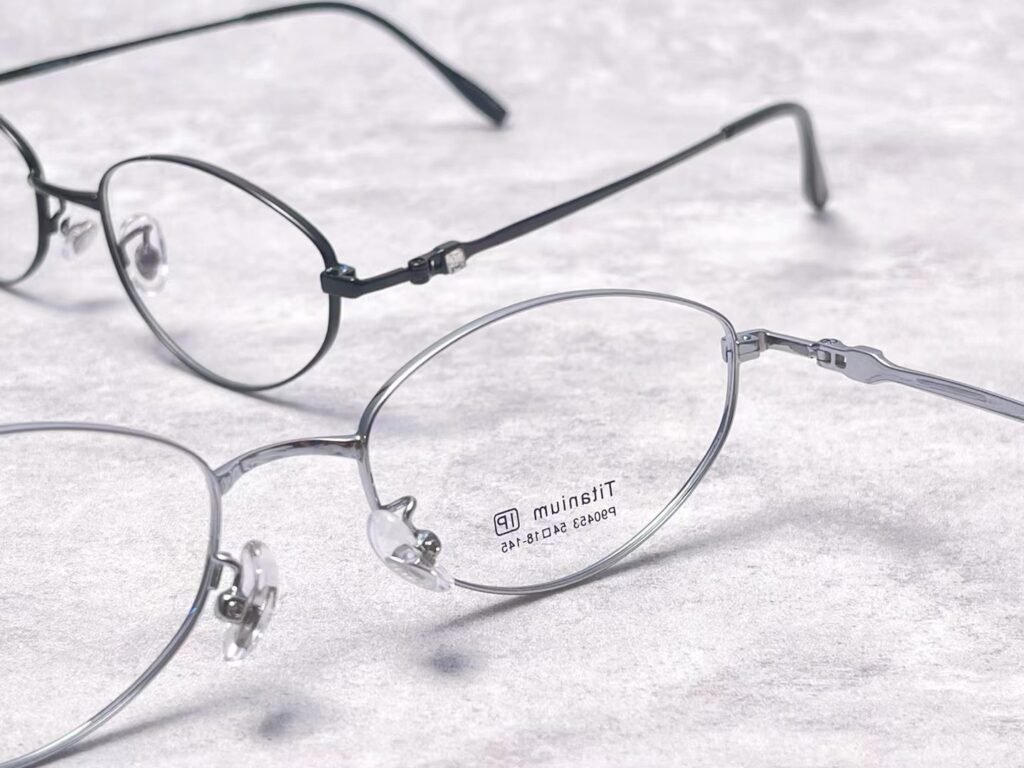
Put three pairs of glasses on a counter. One is made of PC, one of TR90, one of acetate. Paint them the same colour, give them the same shape, and most people cannot tell them apart — not by looking, and not in the first ten seconds of holding them. Similar glasses cost so much more in one case than another, and the reason is never in how they look.
Those three pairs will leave the factory at noticeably different costs. It comes down to what happened to them between the raw material and the box — how many production steps each pair went through, how much hand time it received, and how many times it was checked before it was packed.
Two pairs of glasses can look identical on the day you buy them and behave completely differently six months later. This article walks through every stage that causes that.
Quick answer: why do similar glasses cost so much more in one case than another? Because four things a photograph cannot show you decide most of the cost — what the material really is, how many processing steps the glasses go through, how much hand time each pair receives, and how many times it was inspected before packing. None of them affect how the glasses look. All of them affect how they feel in month six.
What this article covers: how glasses are made · why materials matter · the production line stage by stage · where extra spending pays off · lens prices explained · what to check before buying
Everything that drives the cost of a pair of glasses happens in a fixed sequence. Here is the whole journey in one view:
Two stages in that list are worth pausing on.
Polishing and barrel tumbling look like the least impressive part of a factory. They are actually two of the most expensive. Tumbling a batch of frames is a slow process measured in hours, and it cannot be hurried — running the barrel faster does not produce the same result, it produces scratched parts. Hand polishing at the end is skilled work, and a pair that has been polished properly feels different on your nose and behind your ears on the first day and on the five-hundredth.
Inspection takes place in the middle of the process, not just at the end. That is deliberate, and the stage-by-stage section explains why it matters more than almost anything else on this page.
This is where the biggest cost differences hide, because “plastic frame” describes three completely different production processes — and three pairs of glasses that look alike on a shelf.
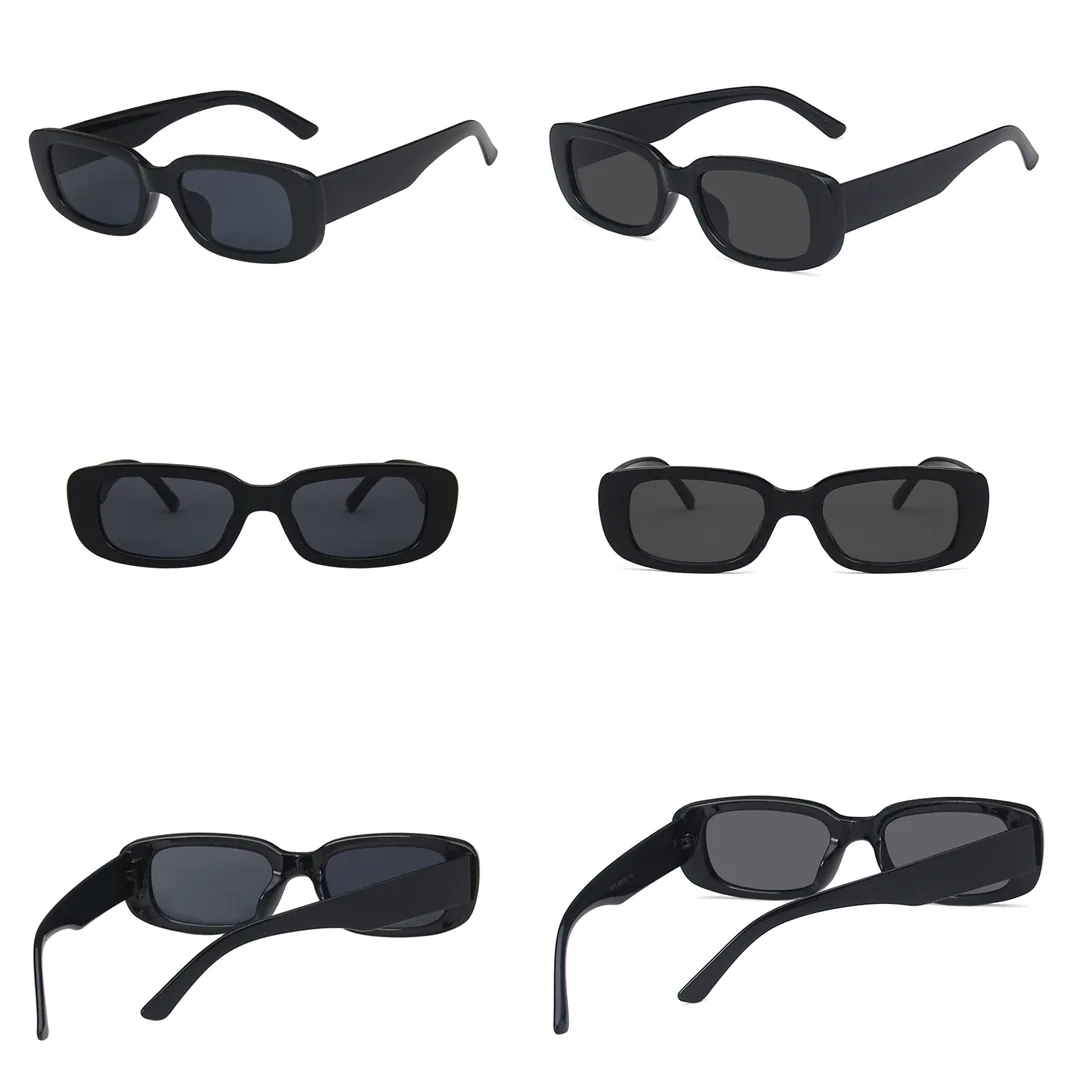
Here is what separates them.
Plastic pellets are melted and injected into a steel mould, and the frame comes out close to its final shape. It is fast, it uses very little labour, and almost no hand work is involved. The surface you get is the surface the mould gives you. PC resists impact well, but it is stiff and hard — it does not bend, so it tends to crack at stress points like the hinge or a thin bridge.
Where the cost comes from: machine time and the material itself. Almost nothing else.
TR90 is a nylon-based material, also injection moulded, but it behaves like the opposite of PC. It is springy — you can bend it and it springs back — and it is roughly half the weight of acetate. Because it flexes rather than cracks, it is the standard choice for TR90 frames used in sports and children’s eyewear.
The catch is colour. TR90 is harder to paint than it looks: paint does not naturally grip its surface. Factories that skip the surface preparation step, or rush it, produce glasses where the paint flakes off in patches after a few months of sweat and sunlight. This is a real technical problem, not a cosmetic one.
Where the cost comes from: machine time, plus the surface preparation before painting — invisible when it is done well, obvious when it is not.
Acetate is not moulded at all. Acetate frames start life as solid sheets — a plant-based material made from cotton fibres and wood pulp — and the frame shape is cut out of those sheets rather than formed in a mould. The cut parts then go through grinding and a long polishing process, usually starting in tumbling barrels and finishing by hand.
Because the material is layered, acetate can hold depth, marbling and tortoiseshell patterns that moulding simply cannot reproduce. It is also the heaviest of the three, and it needs heat if it ever has to be adjusted to your face. You can see the range in our optical frames collection.
Where the cost comes from: time. Hours of tumbling and hand polishing per batch, and significantly more labour per pair than either moulded option.
| PC | TR90 | Acetate | |
|---|---|---|---|
| How it is made | Injection moulded | Injection moulded | Cut from sheets |
| Colour applied | In the material | Painted on | In the material, layered |
| Hand time per pair | Very little | Little | A lot |
| Weight | Light | Very light | Medium |
| If you bend it | Cracks | Springs back | Needs heating |
| Main weakness | Cracks at stress points | Paint adhesion | Warps in high heat |
| Relative production cost | Lowest | Low | Highest |
Why the three can look identical. Because you can paint a moulded frame so that it looks like acetate, and at arm’s length it will. The appearance is achievable on the cheap. The behaviour is not. That is why the honest comparison is not what a pair of glasses looks like on a shelf — it is what it looks like after a year of being put on and taken off twice a day.
There is a second layer of cost hiding inside each material name, too. Within “acetate” you will find fully fresh material, and you will find blends and recycled material. Within injection plastics, the consistency of the granules changes how the material flows into the mould — and whether parts crack later at thin points. Same word on the label, different behaviour in the hand. This is worth asking about directly, because it will never be visible in a product photo.
Now the part most buyers never get to see. Similar glasses cost so much more when one pair skipped a stage, another was rushed through it, and a third was never inspected at all — so here is what each stage does, what spending more there actually buys you, and where extra money is genuinely wasted.
A useful rule to keep in mind before reading: a defect gets more expensive the further it travels down the line. A flawed part caught before assembly costs you the material. The same flaw caught after assembly costs you the material, the other parts it was joined to, the time spent assembling it, and the box. That single fact explains most of what follows.
Before a single frame exists, a mould has to be cut. This is the most consequential spending decision in the whole process, because the mould decides the shape, the surface finish and how consistently parts fit together for every pair that follows. A good mould produces parts that need almost no correction. A poor one produces parts with visible marks, uneven thickness, and a steady stream of rejects that only show up several stages later.
Worth spending on? Yes — mistakes here follow the entire production run.
The material is heated and pushed into the mould, then cooled. The cost here is machine time plus material grade. The invisible variable is cooling discipline. If parts are pulled out of the mould while still warm inside, stress stays locked in the material. It shows up weeks later as warping or a crack at a thin point — long after the glasses have been packed and shipped.
Worth spending on? Yes, on two things: fresh material rather than blended, and enough cooling time. Neither is visible on the day of production. Both decide what happens in month two.
Parts come off the mould attached to a frame of runners. They are separated, trimmed and sorted. On its own this is a low-cost step.
Worth spending on? Usually not — this is a stage worth keeping simple, provided the mould is good. With well-cut tooling there is very little remedial work to do here. In a factory running poor moulds, this stage quietly turns into a repair station, and the extra cost is really the cost of bad tooling showing up.
Colour, gloss and surface protection are applied. The whole quality question at this stage is adhesion — whether the coating actually bonds to the material underneath.
Adhesion is decided almost entirely by the surface preparation performed before any paint is applied. That preparation is invisible in the finished product. It is also the single difference between a finish that still looks good in year two and one that flakes off in patches by month three. On TR90 this step is not optional: the material’s smooth surface resists paint, and skipping preparation guarantees failure.
Worth spending on? Absolutely — one of the best-value places to spend. You cannot inspect a finished pair of glasses and see whether the preparation was done properly. You can only see the result months later.
This stage deserves its own heading, because it is where quality is genuinely bought or lost.
At this stage a flaw costs very little to fix, because nothing valuable has been added to the part yet. Catch a warped frame here and you lose some material. Catch the same warped frame after assembly and you lose the material plus the hinges, the temples, the nose pads, the assembly time and the packaging — and you still have to replace it.
Worth spending on? Yes, more than most factories do. But one honest caveat: an inspection station only has value if something is actually rejected. A check that never finds anything is either a very good process or a formality with a stamp next to it, and from the outside the two look identical. So the useful question for any supplier is not “do you inspect?” but “what proportion of parts do you reject, and at which stage?” A factory that rejects nothing is not perfect; it is not looking.
If you want to see how we control frame quality at this stage in practice, that page goes through the inspection gates we run.
On metal frames, the joints hold the whole thing together, and they are the most common failure point on any metal pair of glasses. Joint strength comes from the welding method, the depth of the bond, and the material being welded — which is one reason titanium and stainless steel behave so differently from budget alloys.
Worth spending on? Yes — a weak joint is invisible until the day it lets go.
Polishing smooths the edges and the contact points — the bridge of your nose, the tops of your ears. It is skilled, hands-on work, and the difference is felt rather than seen.
There is a limit, though: polishing too far removes material and creates thin weak spots. A frame can be polished into being fragile. Good polishing is a judgement call as much as an effort — which is why this is one of the stages where an experienced team matters more than an expensive machine.
Worth spending on? Yes — up to the point where it starts costing strength.
Frames are placed in rotating barrels with polishing media and left for hours. This is the stage that gives acetate its deep finish and rounds every edge consistently across a batch.
Worth spending on? Yes, and it cannot be shortcut. Time is the active ingredient here. This is a large part of why an acetate pair of glasses carries more cost than a moulded one, and it is not waste — it is the product.
Hinges, temples and nose pads are fitted and aligned. The variable that matters is how closely each part matches its intended dimensions, because that is what decides whether the glasses sit level on your face or develop a slow tilt.
Worth spending on? Yes — specifically on the hinge and on tightening the dimensional standards. A hinge is a small part that decides whether your glasses still open smoothly in two years.
The last check before packing. Everything that fails here has already absorbed the full cost of being made — which is exactly why catching problems earlier matters so much.
Worth spending on? Right-sized, not maximum. Glasses need real protection for shipping and storage; they do not need four layers of presentation that get thrown away in. For an export order, packaging that protects is essential. Packaging beyond that is money you pay for and never use.
The unglamorous final stage. Acetate in particular does not like prolonged heat, and stock stored badly arrives warped. Good storage is cheap insurance.
If you take one table from this article, take this one. It is the practical version of everything above.
| Spend here — you will feel it | Keep it simple — you will not feel it |
|---|---|
| Fresh material instead of blended or recycled | Extra packaging layers beyond what protects the glasses |
| A well-cut mould and enough cooling time | Cosmetic steps that add no strength or comfort |
| Surface preparation before painting | Many colour options split across a small order |
| A real specification for hinges and joints | Decorative hardware |
| Enough tumbling and polishing time on acetate | Speeding up a stage that is already producing good parts |
| Inspection gates at semi-finished and final stages | Duplicate checks that never reject anything |
| Accurate lens fabrication | Over-thin lenses on a mild prescription |
The pattern is consistent: money spent on material grade, on time, and on checking things early shows up in the product for years. Money spent on appearance, on extra packaging and on unnecessary thinness disappears the moment you open the box.
Frames hold lenses. Lenses are what you actually look through, and this is the part of eyewear where spending more can genuinely change your experience — provided you spend it in the right place.
You have seen the numbers: 1.50, 1.61, 1.67, 1.74. That number is the refractive index — simply how strongly the material bends light. A material that bends light more strongly needs less of it to correct the same prescription, so the lens comes out thinner and lighter.
Here is the thing almost nobody explains clearly: a higher number does not correct your vision any better. It gives you exactly the same correction in a thinner piece of material. It is about how the glasses look and how much they weigh, not about how well you can see.
Higher-index materials are genuinely harder to make — they need specialised ingredients, longer curing, and more precise grinding — which is why the price climbs with the number. The optical requirements these lenses have to meet are themselves standardised; the ISO 8980-1 specification for uncut finished spectacle lenses sets out the optical and geometric properties a lens has to satisfy.
| Your prescription | Sensible choice | Why |
|---|---|---|
| Under ±2.00 | Standard 1.50 or 1.59 | Thickness is not yet a visible problem |
| ±2.00 to ±4.00 | 1.61 | The first step where the difference is obvious |
| ±4.00 to ±6.00 | 1.67 | Good balance of thinness, weight and optical quality |
| Above ±6.00 | 1.74 | At this strength, the thinning is worth the trade-offs |
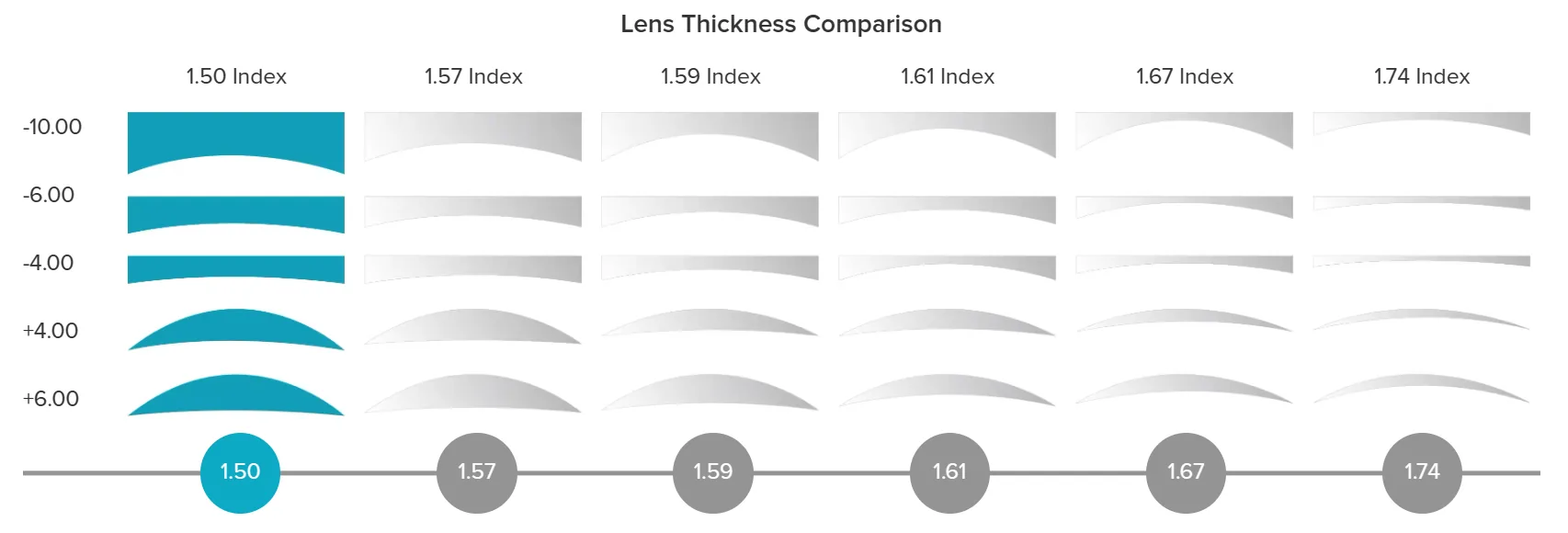
Two things most price lists leave out.
Your frame size changes the answer. A lens is thinnest in the middle and thickest at the edge, so a wide frame carries far more visible edge thickness than a small one at exactly the same prescription. Someone at ±3.50 in a large frame may be justified in choosing 1.67, while someone at ±4.50 in a small, thick-rimmed frame may be perfectly happy in 1.61.
The gains shrink with each step. Going from standard plastic to 1.61 is the most visible upgrade most people ever make. Going from 1.67 to 1.74 is real but subtle below about ±6.00 — once the glasses are on your face, most people cannot tell the two apart. If someone is selling you 1.74 on a mild prescription, they are selling you a number rather than a benefit.
| Feature | What it does | Who genuinely benefits |
|---|---|---|
| UV400 protection | Blocks ultraviolet light | Everyone. Non-negotiable |
| Anti-reflective coating | Cuts glare and reflections | Almost everyone — the best-value upgrade available |
| Hard coat | Resists scratching | Everyone, especially if you clean lenses on your shirt |
| Hydrophobic / oleophobic | Repels water and smudges | Anyone who cleans their glasses often |
| Blue-light filtering | Reduces some screen-related strain | Heavy screen users — helpful, frequently oversold |
| Photochromic | Darkens in sunlight | People who move indoors and outdoors constantly |
| Progressive design | Corrects near and far in one lens | Anyone over 40 with a reading add |
One technical point that matters in practice: a 1.74 lens essentially requires an anti-reflective coating, because the denser material reflects more light. Without it you get glare and ghosting. On cheap lenses, an absent or badly applied coating is one of the most common invisible cutbacks — the glasses look fine, and then you drive at night.
This is the part that decides whether a pair of glasses actually helps you, and it is almost never discussed on a price tag.
Traditional lens production works to a precision of roughly 0.12 dioptres. Digitally surfaced lenses can reach around 0.01 — about an order of magnitude finer. They can also place both the reading zone and your prescription on a single surface, adjusted for your pupil distance and the frame you chose. In plain terms: a wider reading area, and less of the “swimming” sensation that makes people give up on progressive lenses entirely.
It costs more at the lab, and unlike some upgrades, the money is going into the optics rather than the look. If you sell glasses rather than buy them, progressive and digital lenses are worth understanding in detail — they are one of the few genuine quality differences you can point a customer towards without overselling.
Where lens money is best spent, in order: accurate fabrication first, then anti-reflective coating and UV400, then whichever function matches how you actually live. The index comes last, and only if your prescription justifies it.
That last point matters more than it sounds. Despite the growth of online eyewear, more than 80% of frames and lenses are still bought in person. For most people, fitting and adjustment are part of what they are paying for — and they are exactly the parts you cannot check from a photograph.
Do glasses made of PC, TR90 and acetate really cost the same to make?
No. PC and TR90 are moulded and need very little hand work. Acetate is cut from sheets and then tumbled and polished for hours. That labour is the difference — which is why an acetate pair of glasses can cost several times more to produce than a moulded one that looks almost identical.
Why do similar glasses cost so much more in one shop than another?
Because the same frame can be sold with very different lens packages, and because what is included varies. One seller may bundle a basic lens with the frame; another may line-item every coating. Comparing two totals without normalising what is inside them is comparing two different products.
Can cheap glasses damage my eyesight?
The price itself is not the risk — the accuracy is. A well-made low-cost pair of glasses with an accurately made lens is a perfectly good purchase. What causes eyestrain, headaches and distortion is a lens that does not match your prescription, a lens that has been scratched, or a frame that fits so poorly it holds the lens off-centre. None of those are about price; all of them are about whether anyone verified the work.
Which production stage is worth paying more for?
In order of how much you will actually feel it: the material grade, the surface preparation before painting, the hinge and joint specification, the tumbling and polishing time, and inspection early in the process. Those five decide how the glasses behave after the honeymoon period. Extra packaging and extra colour options do not.
Is titanium worth the extra money?
If you have reacted to metal frames before, or you want the lightest possible pair, yes. Titanium is around 40% lighter than steel with similar strength, and it does not corrode or trigger nickel allergies. If those are not problems for you, stainless steel is a reasonable choice.
Why does inspection matter so much to the cost?
Because a defect gets more expensive the further it travels. Caught before assembly, a flawed frame costs some material. Caught after assembly, it also costs the hinges, the temples, the labour and the box — and it still has to be replaced.
Do I need the thinnest lens available?
Only if your prescription and your frame justify it. Above roughly ±6.00, 1.74 makes a visible difference. Below about ±4.00, it usually does not. Your frame size affects the answer as much as your prescription does.
How long should a good pair of glasses last?
With normal care, a well-finished frame and a properly coated lens should serve you two to three years, often longer. If a pair loosens, discolours or breaks within months, the cause is usually material grade or a finishing stage that was rushed — not how you treated it.
Similar glasses cost so much more in one case than another for one reason: one of them went through fewer steps, received less hand time, and was checked fewer times.
You cannot see any of that on a shelf. So the useful questions are not about how the glasses look. They are about what they are made of, how they were finished, and whether anyone actually looked at them before they were packed.
We are a manufacturer, so we have an interest here — but the interest runs both ways. It is better for us if buyers know what the production stages are, because then a pair of glasses can be judged on how it was made instead of how it photographs. If you would like to see the range those stages produce, start with our eyewear catalog.
For optical retailers and distributors: if you are sourcing frames and want to know exactly which material grades, finishing standards and inspection gates sit behind a quotation, talk to our team — we will go through the specification stage by stage.
For anyone buying glasses: name the material, ask about the hinge, confirm your pupillary distance was measured, and make sure your lens index suits your prescription rather than the sales target. That covers most of what matters.
 Eyewear Retail Insights
 Eyewear Retail Insights
 Eyewear Retail Insights