
Every optical retailer has a number they would rather not say out loud: their eyewear returns figure. The refunded pair. The remake that takes three weeks and one difficult phone call. And the customer who never argues at all — they simply never come back.
Eyewear returns are usually written off as the cost of doing business. They should not be, because the true cost of a single return is far larger than the refund itself:
Here is the encouraging part. Complaint data from optical markets around the world points to the same conclusion: the vast majority of eyewear returns trace back to a handful of repeatable mistakes, not to difficult customers. In the UK, the optical sector’s own complaints service reports that prescription accuracy is consistently its single largest complaint category, while complaints about charges and refunds have been growing faster than any other type. Which means this: eyewear returns are a process problem — and process problems are fixable.
Below are the seven mistakes we see most often. We see them from an unusual angle: we manufacture eyewear for retailers worldwide, and we also run our own chain of optical stores in China. Every one of these has happened on our own shop floor.
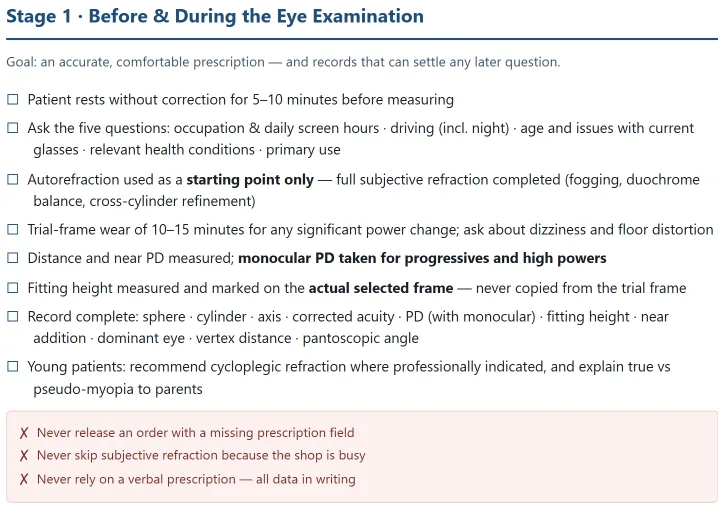
The machine gives a starting point, not an answer. Eyes that have been on a screen for ten hours arrive with accommodative spasm, and a reading taken in that state can be off by enough to cause headaches, blur and a return visit. Yet in a busy shop, subjective refraction, the duochrome balance and the cross-cylinder refinement are the first things to be skipped.
How to fix it:
Slowing down stage one is the cheapest eyewear returns prevention that exists.
This is the silent one. The power can be perfect and the glasses still fail, because the optical centres do not sit in front of the pupils. Consumer testing in the Netherlands found that with online-ordered spectacles, pupil distance and fitting height were frequently wrong — and half of the test pairs came back. In-store, the same error appears when staff measure on a trial frame and copy the numbers across to the chosen frame, or skip monocular PD altogether.
The College of Optometrists found the same pattern in its own research: spectacles purchased online were twice as likely to fail optical tolerance tests as those dispensed in practice, largely because patients measured and supplied their own pupillary distance. Wrong geometry is one of the most reliable drivers of eyewear returns — and one of the easiest to eliminate.
How to fix it:
A crooked fit does not only look wrong — it physically shifts the lens geometry, undoing the centration you just worked to get right. One well-known German consumer test put six major optical chains through real fittings: not one of them earned the top rating, and every single one had problems at the adjustment step. The customer experiences the result as “these glasses don’t suit me” — and returns them.
How to fix it: adopt a fixed five-step routine before handover — face form, pantoscopic tilt (8–12°), vertex distance (12–14 mm), pads sitting evenly without pressure marks, and temple bend behind the ear. Then have the customer look up, down, left and right before they leave. Five minutes at the counter beats a five-day remake.
“Blue light protection” has become the industry’s most dangerous phrase. Advertising regulators have repeatedly upheld rulings against eyewear claims that could not be substantiated — including blue-light harm claims supported only by animal studies, and “drive safer at night” claims with weak evidence behind them. When a customer buys a lens because they were told it would protect their eyes, and their eyes still feel tired at the end of the day, they conclude that the product — and your store — is a scam. That is an eyewear return with reputational damage attached.
How to fix it: sell what you can demonstrate. “Filters part of the 415–455 nm band from screens” and “many wearers report less screen fatigue” are honest, defensible, and they still sell. Train the floor team on one fixed claims script, and make sure your supplier gives you spec sheets that support every sentence of it.
Six months later the coating starts to peel, and the argument begins — because nobody defined anything at the start. Is peeling covered? Are scratches? How many free adjustments are included? In market after market, warranty refusal ranks among the most common after-sales complaints in optical retail, and in nearly every case the dispute exists because the terms were never written down at delivery.
How to fix it: a warranty card, or a digital record, signed at handover — stating the duration, what is covered (manufacturing defects such as peeling, bubbling and discolouration), what is not (scratches, impact damage), and how many free adjustments are included. One signed card removes the industry’s most common argument before it starts.
When a customer comes back dizzy, the fastest way to lose them forever is to say “you’ll get used to it.” Sometimes that is true — but saying it before you re-measure is a bet on your reputation. Complaint-handling failure is so widespread that “the store didn’t deal with my complaint” consistently ranks among the top complaint types in sector statistics, ahead of most product issues.
How to fix it: use a fixed triage order — re-check the frame adjustment first, then optical centre against PD, then fitting height, then power and axis, and only then call it adaptation. Publish your process as well: acknowledge within 24 hours, propose a solution within 48. Customers forgive defects far more readily than they forgive being handled badly.
This is the mistake retailers make most often, precisely because it does not feel like theirs. But look at where eyewear returns actually originate:
A cheap supplier with weak quality control is the most expensive supplier you can hire. Materials and production stages are where that difference is created, long before the frame reaches your shelf — we broke the full picture down in why similar glasses cost so much.
Here is what we have learned from an unusual position: DAQRI is not only an eyewear factory. We run our own chain of optical retail stores in China — and those stores are where our standards were written.
Every mistake in this article has happened on our own shop floor. Every fix has been tested on real customers before it reached this page. That changes what we can do for the retailers we supply:
Most suppliers sell you frames and lenses. We would rather be the partner who helps you keep the customers you have already won — because we have stood on your side of the counter. You can see how we support partners after the sale on our after-sales support page.
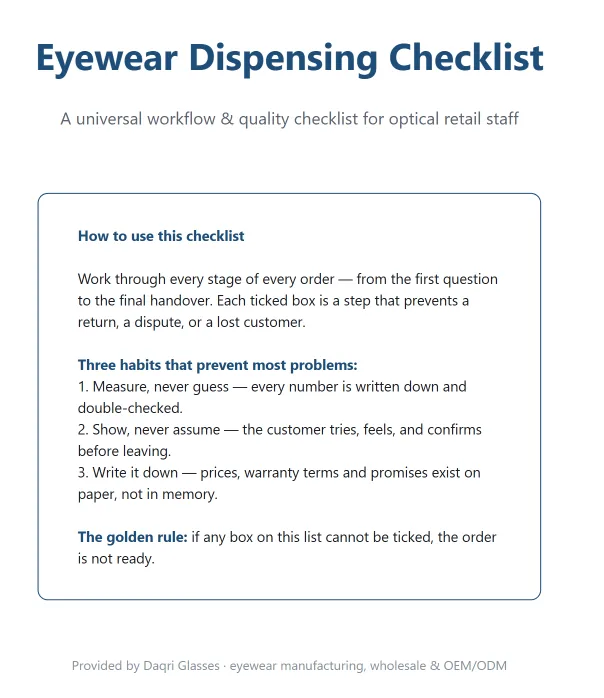
We took everything above, added the steps our own store managers insist on, and turned it into a printable checklist your team can use at the counter. It covers all six stages of the dispensing workflow, the numbers worth memorising, and the exact phrases that stop complaints from escalating.
If eyewear returns and remakes are eating into your margins, let’s talk. We supply optical frames, sunglasses, sports eyewear and accessories to retailers worldwide — with the QC standards, documentation and retail-experience support that come from running stores ourselves.
More reading from our retail team: why screwless TR90 frames never rust, and how materials and production stages decide whether a frame survives its first year. Browse all Eyewear Retail Insights.
Across complaint data and our own store experience, the leading cause is not frame breakage — it is visual discomfort: power, PD or fitting-height errors that make the glasses feel wrong. The second tier is expectation mismatch, where features were oversold or warranty terms were never made clear.
Four concrete ways: consistent incoming quality so fewer products fail in the first year; protective single-unit packaging so nothing arrives scratched; complete documentation so your claims are provable; and spare parts plus fast remakes so repairs do not turn into refunds. Ask any prospective supplier to commit to all four in writing.
Yes, because most fixes add minutes rather than hours. A trial-frame wear and a proper five-step adjustment take under ten minutes combined, and together they prevent the two largest categories of eyewear returns. The real time sink is the return itself: the remake, the phone calls and the lost customer.
Rules differ by market. In the EU, distance-selling rules give consumers a 14-day right of withdrawal, but custom-made items are exempt — worth stating clearly at online checkout. Elsewhere, statutory warranty periods apply to defects regardless of store policy. The safest approach everywhere is the same: put your terms in writing at the point of sale.
 Eyewear Retail Insights
 Eyewear Retail Insights
 Eyewear Retail Insights