
The DDP vs EXW question comes up on almost every first eyewear order, and it is almost always framed the wrong way: buyers compare the three-letter codes instead of the money that actually leaves their account. Three suppliers quote you USD 2.10, USD 2.40 and USD 2.83 per pair for what looks like the same TR90 frame. You assume the first quote is the cheapest and place the order.
Six weeks later the shipment lands at your warehouse and the real cost per pair turns out to be USD 2.90 — because the USD 2.10 was an EXW price and every step from the factory gate was yours to arrange and pay for: export paperwork, trucking to the airport, air freight, destination handling, customs clearance, duty, and the last-mile delivery.
The USD 2.83 quote was DDP — and when the whole DIY column was finally costed, it did not beat the DDP price. It landed about 2.5% above it, and it consumed six weeks of the buyer’s attention.
That is the counter-intuitive part of eyewear sourcing: for air-shipped frames, doing the logistics yourself is usually slightly more expensive than buying DDP — and much more expensive on small orders, unless you already have a forwarder working at consolidated rates. Either way, the number you have to compare is the to-door price, never the product price.
This guide is for buyers who are not yet comfortable with Incoterms. It explains what the four terms you will actually see on eyewear quotations mean, who carries cost and risk at each stage, why an EXW price and a DDP price for the same product can differ by 35% or more, and how to choose the right term for your situation.
| Question | Short answer |
|---|---|
| What does EXW mean? | Goods are yours at the factory door. You handle export clearance, freight, import clearance, duty and delivery. |
| What does DDP mean? | The supplier delivers to your named address with import clearance and duty paid. One number, nothing to organise. |
| Which is cheaper? | Only a to-door comparison can tell you. On most small orders EXW lands 3–50% above the DDP price once freight, clearance, duty and your own time are added — but if your forwarder already buys those services at wholesale, EXW can win even on 300 pairs. |
| Which should a first-time buyer choose? | DDP, unless you already have a freight forwarder and a customs broker you trust. |
| Do Incoterms include everything? | No. They never cover price level, quality, payment terms, warranty or product compliance. Those belong in the purchase contract. |
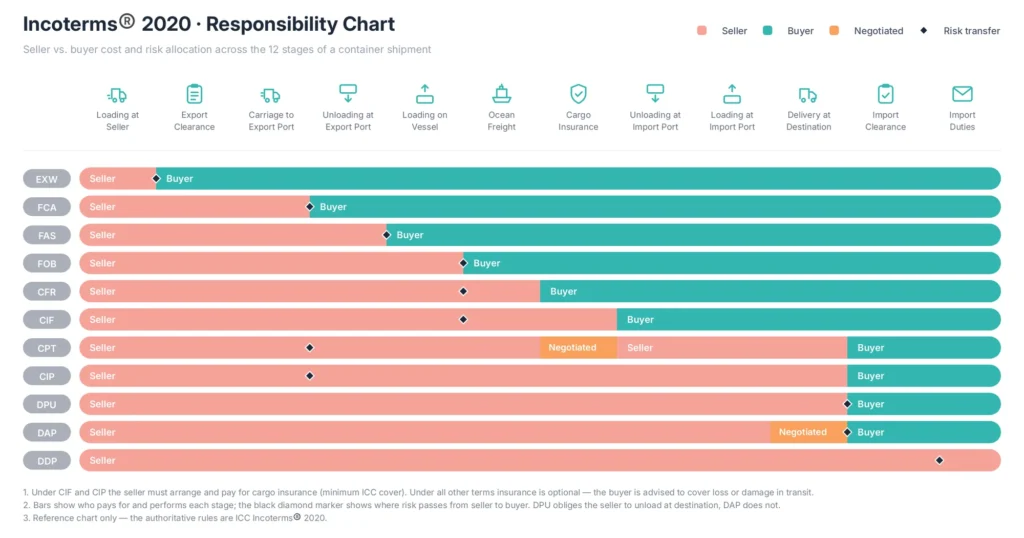
Incoterms® (International Commercial Terms, published by the International Chamber of Commerce, currently the 2020 edition) are three letters plus a named place. They answer exactly four questions:
They do not decide:
A common and expensive mistake: assuming a DDP price means the supplier is also responsible for compliance. It does not. DDP covers transport and duty. It does not make your frames CE-compliant for the EU, nor compliant with the US impact-resistance requirement in 21 CFR 801.410.
Always write the term, the named place and the edition on the proforma invoice — for example DDP, Hamburg 20095, Germany, Incoterms® 2020. “DDP” on its own is not enforceable, because it does not say where.
Eyewear sourcing is dominated by four terms. Two more (FCA, CIF) appear often enough that you should recognise them.
The seller’s only obligation is to make the goods available at its premises. Everything after that — loading the truck, export declaration in China, freight, insurance, import clearance, duty, delivery — is the buyer’s.
The seller trucks the goods to the port, clears them for export, and loads them on board the vessel you nominate. Risk passes when the goods are on board.
The seller pays freight and minimum insurance to your port. Risk still passes at the origin port — the CIF price is a cost arrangement, not a risk arrangement. Many buyers are surprised to learn that under CIF they can be paying for freight on goods that are already their risk and their loss.
The seller delivers to your named destination with import clearance completed and import duty paid. DDP is the only Incoterms rule under which the seller is responsible for import duties.
| DAP (Delivered at Place) | DDP (Delivered Duty Paid) | |
|---|---|---|
| Transport to your address | Seller | Seller |
| Import clearance | Buyer | Seller |
| Import duty | Buyer — invoiced after arrival | Seller, inside the price |
| Import VAT / GST | Buyer (usually recoverable) | Seller, unless carved out by agreement |
| Looks like | A DDP quote minus the duty | The all-in number |
The two rates often differ by only a few percent on paper, which is exactly why the substitution works: the buyer compares “DDP” against “DDP”, picks the cheaper one, and discovers the difference three weeks later in a carrier invoice that includes duty and a brokerage fee. A supplier who is not set up to clear goods in your country — or who simply does not want the duty exposure — has an obvious incentive to quote DAP and label it DDP.
How to protect yourself in one line: ask for the invoice to state DDP, [address], Incoterms® 2020, and ask who the importer of record will be. If the answer is “you”, the rate is DAP whatever the email called it.
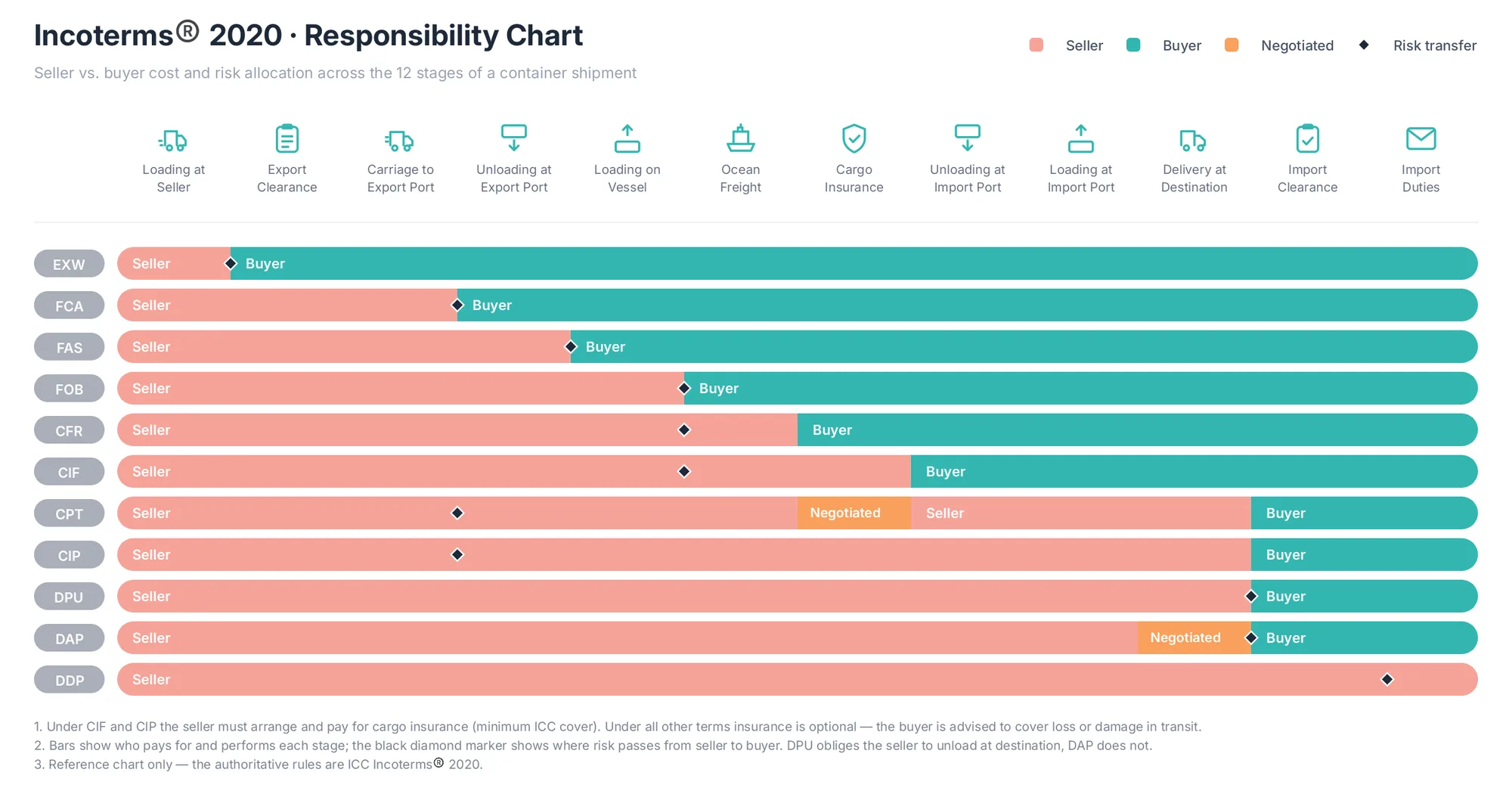
| Stage | EXW | FOB | CIF | DDP |
|---|---|---|---|---|
| Loading at supplier’s premises | Buyer | Seller | Seller | Seller |
| Export clearance (China) | Buyer | Seller | Seller | Seller |
| Inland carriage to export port | Buyer | Seller | Seller | Seller |
| Loading on vessel / aircraft | Buyer | Seller (risk passes) | Seller (risk passes) | Seller |
| Main carriage (freight) | Buyer | Buyer | Seller | Seller |
| Cargo insurance | Buyer | Buyer | Seller (minimum cover) | Seller |
| Import clearance | Buyer | Buyer | Buyer | Seller |
| Import duty and taxes | Buyer | Buyer | Buyer | Seller |
| Delivery to your address | Buyer | Buyer | Buyer | Seller |
| Risk passes to buyer at | Factory | On board, origin | On board, origin | Your address |
Two practical readings of that table:
The unit price gap is not a margin gap. It is a scope gap.
Most buyers assume the DIY route must be cheaper because it cuts out a middleman. For eyewear it usually is not. Frames and sunglasses are light but bulky, so a large share of orders move by air, and air freight is priced on chargeable weight with fixed per-shipment charges attached. That combination punishes small, one-off buyers.
Here is a door-to-door calculation for 3,000 pairs of acetate optical frames, air freight China → EU, 2026 rates.
The weight reality first: 3,000 pairs in retail boxes is roughly 150 kg actual, ~1.2 CBM volumetric — about 200 kg chargeable (airlines bill the greater of actual and volumetric weight, L×W×H ÷ 6,000).
| Cost layer | DIY: EXW + your own air freight | DDP: built into the price |
|---|---|---|
| Goods at factory gate | USD 6,300 | USD 6,300 |
| Export declaration + origin handling | USD 180 | USD 150 |
| Trucking factory → airport | USD 90 | USD 60 |
| Air freight, 200 kg chargeable | USD 1,440 (≈ USD 7.20/kg) | USD 1,040 (≈ USD 5.20/kg) |
| Destination terminal + documentation | USD 120 | USD 90 |
| Customs declaration | USD 180 | USD 70 |
| Import duty (2.2% on frames) | USD 176 | USD 176 |
| Last-mile delivery to your warehouse | USD 150 | USD 110 |
| Clearance delay / storage allowance | USD 60 | — |
| Supplier margin, admin and duty risk | — | USD 500 |
| Total | USD 8,696 | USD 8,496 |
| Per pair | USD 2.90 | USD 2.83 |
| Import VAT (20%) | ≈ USD 1,640 paid upfront, recovered 1–3 months later | none on your side |
Illustrative. Duty depends on HS code and origin; VAT treatment depends on your registration. Air benchmarks used: 2026 China–Europe general cargo USD 3.00–7.00/kg base by weight band (below 100 kg: USD 7–9/kg), plus 15–25% fuel and terminal surcharges; destination brokerage USD 150–350 per declaration; EU duty 2.2% on frames (HS 9003), 2.9% on sunglasses (HS 9004.10).
Read the two columns against each other. The supplier saves about USD 400 on air freight and about USD 300 on fixed charges, then adds back USD 500 of margin, admin and duty risk. The net is roughly USD 200 in your favour — plus three things that never appear on an invoice: your time, your working capital block, and your exposure if the declaration is wrong.
Why the savings are structural rather than a one-off discount:
This is the one habit that separates buyers who control their margin from buyers who discover it after arrival: never compare product prices across Incoterms. Compare to-door prices.
An EXW quote and a DDP quote are not two prices for the same thing — they are two different scopes. Comparing USD 2.10 EXW with USD 2.83 DDP tells you nothing until you know what the USD 2.10 becomes at your door. Sometimes that is USD 2.90. Sometimes — with the right forwarder — it is USD 2.70. If you want to understand why two suppliers quote the same frame at different factory prices in the first place, read why identical-looking glasses cost different amounts.
You do not need a consultant to run it. Six lines, one spreadsheet, ten minutes:
| Line | What to enter |
|---|---|
| 1. Goods | EXW unit price × quantity |
| 2. Origin | Export declaration + origin handling + trucking to airport or port |
| 3. Main carriage | Air or sea freight on chargeable weight (L×W×H ÷ 6,000), including fuel and security surcharges |
| 4. Destination | Terminal handling + documentation + broker fee + last-mile delivery |
| 5. Duty | CIF value × your HS rate (9004.10 sunglasses, 9003.11–19 frames) |
| 6. Landed cost | Sum of lines 1–5 ÷ units. Leave import VAT out if you recover it — but count the cash-flow block |
Put that number next to the DDP price per unit. That is the only comparison that means anything — and it is the comparison we will put in writing for you if you ask for both quotes.
EXW is not the wrong answer, even on a small order. If you already work with a forwarder that has low fixed minimums at your destination, consolidated air rates and a broker relationship, an EXW or FOB purchase of 300 pairs can comfortably beat a DDP price — because you are already buying those same six lines at wholesale. What makes DDP win for most first-time buyers is not the term itself; it is that they have no such forwarder and end up paying retail for each line, one shipment at a time.
So the honest rule is not “DDP is always cheaper”. It is: compare to-door prices, then decide. DDP wins when your alternative is retail logistics; EXW wins when your alternative is wholesale logistics.
This is where the “DIY is cheaper” assumption breaks hardest. Run the same calculation at different order sizes:
| Order | DIY landed per pair | DDP per pair | DIY premium |
|---|---|---|---|
| 300-pair trial, air (≈20 kg) | ≈ USD 4.74 | ≈ USD 3.15 | +50% |
| 1,200-pair first order, air (≈80 kg) | ≈ USD 3.26 | ≈ USD 2.98 | +9% |
| 3,000-pair reorder, air (≈200 kg) | ≈ USD 2.90 | ≈ USD 2.83 | +2.5% |
| 10,000 pairs, sea LCL | ≈ USD 2.33 | ≈ USD 2.32 | +0.4% |
A 300-pair test order is the single most common first purchase in this industry — and on that order the DIY route typically costs roughly half as much again as DDP. The reason is simple: on a USD 630 consignment, a USD 180 broker fee and a USD 150 air minimum do not scale down. Replace those with a forwarder who charges you USD 60 and USD 60, and the column changes completely — which is exactly why you should run your own numbers rather than trust a rule of thumb. Our low-MOQ program exists so a trial order can ship DDP without carrying a full set of standalone minimums.
Two situations — and only the first one is about order size:
1. Volume plus capability. A buyer moving 20+ shipments a year with a contracted forwarder, an in-house or retainer broker, a duty deferment account and a VAT registration that recovers input VAT can usually beat a DDP price by 3–8%. At that point freight and customs are a capability you own, not a service you buy one shipment at a time.
2. A forwarder that already compresses the middle costs. Some small buyers sit inside a larger group, an e-commerce aggregator or a 3PL that books consolidated capacity and charges flat per-shipment fees. If your broker charges USD 60 instead of USD 180 and your air rate is USD 5.50/kg instead of USD 7.20, the DIY column can undercut DDP even at 300 pairs. Order size does not decide this — the rate you actually get does.
The practical instruction that follows: before you accept any DDP price, ask your forwarder for one all-in door quote on the same order, same quantity, same address. If it beats the DDP number, take it — and tell us, because we will happily quote you FOB or EXW against it. If it does not, you have just proved to yourself what the DDP price is worth, which is a better reason to buy on it than any article.
One caution on the numbers above: duty is the least predictable line. Eyewear sits under HS 9004.10 (sunglasses) and 9003.11 / 9003.19 (frames). Base rates are modest — around 2–3% in the EU and UK — but additional trade measures on China-origin goods can multiply that several times in some markets, and misclassification is one of the most common reasons a landed cost blows past budget. If you are re-exporting rather than selling locally, the tariff logic gets harder again — we covered that in re-exporting eyewear to Latin America. Under DDP that volatility is the supplier’s problem. Under EXW it is yours.
The DDP vs EXW decision is really a question about your own logistics, not about the goods. Match your situation to a row:
| Your situation | Recommended term | Why |
|---|---|---|
| First order, testing a supplier or a style | DDP | Cheapest landed cost at this size, and no customs risk on an already-risky decision |
| Retail chain or distributor with no import department | DDP | No broker relationship, no deferment account, no import VAT to fund |
| Selling on Amazon FBA or via a 3PL | DDP to the FBA/3PL address | Avoids delivery appointments and re-labelling surprises |
| You already have a forwarder + broker and buy monthly | FOB or FCA | At that frequency you can beat a DDP price by 3–8% and see the real cost |
| Your forwarder can quote an all-in door price at low fixed cost | EXW or FOB, even on 300 pairs | Order size does not decide it — the rate you actually get does |
| Seasonal restock needed in 5–8 days | DDP by air | Speed without the clearance learning curve |
| VAT-registered in the EU/UK and need to recover import VAT | DAP or FOB | You control the import declaration and reclaim VAT directly |
A workable progression for most buyers: start DDP for the first one or two orders, learn your true landed cost from the invoice rather than from a spreadsheet, then move to FOB/FCA once you have a contracted forwarder and the volume to justify managing it.
Most “supplier A is cheaper” conclusions are wrong because the quotes were not on the same basis. Use this template in your RFQ:
Please quote 1,200 pcs, style [X], on both EXW [factory city] and DDP [full address incl. postcode], Incoterms® 2020. For the DDP price, please confirm that import duty is included in the price and that you are the importer of record — if either is not the case, please quote DAP instead so we are comparing the same scope. Also confirm whether import VAT/GST is included or zero-rated against our VAT number, that destination terminal charges and last-mile delivery are in scope, and the HS code you will declare.
Four answers to insist on:
And one question to ask your own forwarder, not your supplier: “Same goods, same quantity, same delivery address — what is your all-in door price?” Send both numbers to the same spreadsheet. Buyers who do this once tend to stop arguing about unit prices entirely.
DAQRI Glasses is the export arm of a large Chinese optical retail group, with our own factory covering injection moulding, painting, assembly, packing and warehousing. That vertical control matters more for DDP than buyers expect: accurate carton dimensions, accurate weights and accurate HS classification are what make a DDP price reliable instead of a guess — and eyewear is a category where a badly measured carton can add 30% to chargeable air weight before the goods even leave the building.
We also ship on consolidated air capacity every week, which is the practical reason our DDP price usually sits below what a first-time buyer can assemble independently on a single 50–200 kg shipment. We are buying the same service at trade rates, and spreading the fixed charges across many orders.
What we support:
What DDP does not change: you remain responsible for market compliance, labelling and product liability in your own country, and for your own VAT recovery. We will tell you what we can document; your customs adviser tells you what your market requires.
The result is simple: one price, one contact, and no invoice arriving three weeks after the container does.
What is the difference between DDP and EXW in one sentence? Under EXW the goods are yours at the factory door and you organise and pay for everything after that; under DDP the supplier delivers to your address with import clearance and duty paid.
Is DDP more expensive than FOB or EXW? The DDP price is higher because it contains more cost — but the landed cost usually is not. For air-shipped eyewear, a self-managed EXW import typically lands 2–10% above the DDP price on a normal order, and 40–50% above it on a small trial order, because a one-off buyer pays retail air rates plus per-shipment minimums for brokerage, terminal handling and delivery. That is a default, not a law: if your forwarder already gives you consolidated rates and low fixed fees, EXW can come in below DDP even on 300 pairs. Compare to-door prices.
Can I buy EXW on a small order? Yes. Order size is not what decides the term — the logistics rates you can access are. A 300-pair order works on EXW if you have a forwarder with low destination minimums and a broker who will clear a small consignment at a flat fee. Without that, the fixed charges dominate a USD 630 consignment and DDP ends up cheaper.
Does a DDP price include import VAT or GST? Duty, yes — that is what “Delivered Duty Paid” means, and a quote that excludes duty is DAP. VAT is the part that varies. Some DDP quotes include import VAT; many exclude it, or clear against your VAT/EORI number so VAT is accounted for on your own return. Both are legitimate as long as they are written down, because the tax position changes your cash flow and your recovery. Ask which one you are being quoted.
Is DDP the same as DAP? No, and confusing them is the most common form of invoice surprise in this trade. Under DAP the seller delivers to your address but does not clear the goods for import or pay duty — you do. Under DDP the seller does both. A rate that looks like DDP but excludes duty is a DAP rate, and the duty will be invoiced to you after arrival, usually with a brokerage fee attached.
Who is the importer of record under DDP? It depends on the destination country and how the shipment is structured — it may be the seller, the seller’s customs agent, or you. This is a legal role carrying the compliance obligation, so confirm it in writing before the first shipment.
Do I need my own customs broker if I buy DDP? No. That is the point of DDP. You may still want a broker for advice on classification and on recovering VAT.
What happens if the duty rate changes after I have been quoted? Duty sits inside a DDP price, so a tariff change affects the seller’s cost. Reputable suppliers reserve the right to re-quote if trade measures change between quotation and shipment — ask how your supplier handles this, and get the validity period of the quote in writing.
Can I use DDP for one order and FOB for the next? Yes. Incoterms are agreed per contract. Many buyers start DDP and migrate to FOB/FCA as volumes grow.
Which term is best for a first eyewear order? DDP, in most cases. Your first order already carries product, quality and compliance risk; adding customs risk on top is usually a false economy.
Do Incoterms include cargo insurance for glasses? Only CIF and CIP require the seller to insure. Under EXW, FOB and DDP neither party is obliged to insure, so confirm cover separately — eyewear is fragile, light and high-value, and easily under-insured.
Does the Incoterm affect my duty rate? No. Duty depends on HS code, origin and destination — not on the Incoterm. The Incoterm only decides who arranges and pays for it.
Can you ship DDP to Amazon FBA or to my 3PL? Yes, where the destination is covered. Send us the exact FBA/3PL address and appointment requirements at quote stage.
What if no Incoterm is written on the proforma invoice? Then you are relying on assumptions, which is where disputes come from. Ask for the term, the named place and “Incoterms® 2020” to be added in writing before you pay the deposit.
Tell us your destination city, order quantity and target styles and we will send you two comparable quotes — one EXW, one DDP to your door — with the included cost layers itemised. You can then compare them on the only basis that matters: landed cost per pair.
Request a DDP quote — send your destination city, quantity and two or three target styles, and we will reply with both an EXW and a DDP number on the same order.
Incoterms® is a registered trademark of the International Chamber of Commerce. This article is general commercial guidance, not customs or legal advice. Duty rates, VAT treatment and compliance requirements vary by market and change frequently — confirm them with a licensed customs broker before you place an order.
 Eyewear Sourcing
 Eyewear Sourcing
 Eyewear Sourcing