

Most buyers describe a glasses hinge with one word — single, double or triple tooth — and assume that settles compatibility. It does not, and the range of glasses hinge types is the reason. A hinge has two independent variables, and matching only one of them is the most common reason a replacement temple arrives and will not seat.
This guide sets out the full range of glasses hinge types: three tooth counts, four head profiles, twelve theoretical combinations, the three that are not standard, and the four measurements that decide whether a specific temple actually fits a specific frame. It is written for buyers and optical retailers evaluating replacement or retrofit temples, where a hinge error is not a cosmetic complaint but a part that cannot be used at all.
The hinge is a three-part joint: an endpiece (桩头) moulded into or welded onto the frame front, a knuckle on the temple, and a screw passing through both. The knuckle is split into tabs — the teeth — that interlock with the endpiece. When the temple folds, the screw carries the whole torsional load; when the frame is worn, it carries the weight of the temple plus any load transferred from the fit.
That makes the hinge the highest-stress point in a pair of glasses. Frame standards reflect it: EN ISO 12870 specifies mechanical requirements for spectacle frames, including endurance testing of the hinge and screw assembly. The hinge is a tested component, not a cosmetic detail.
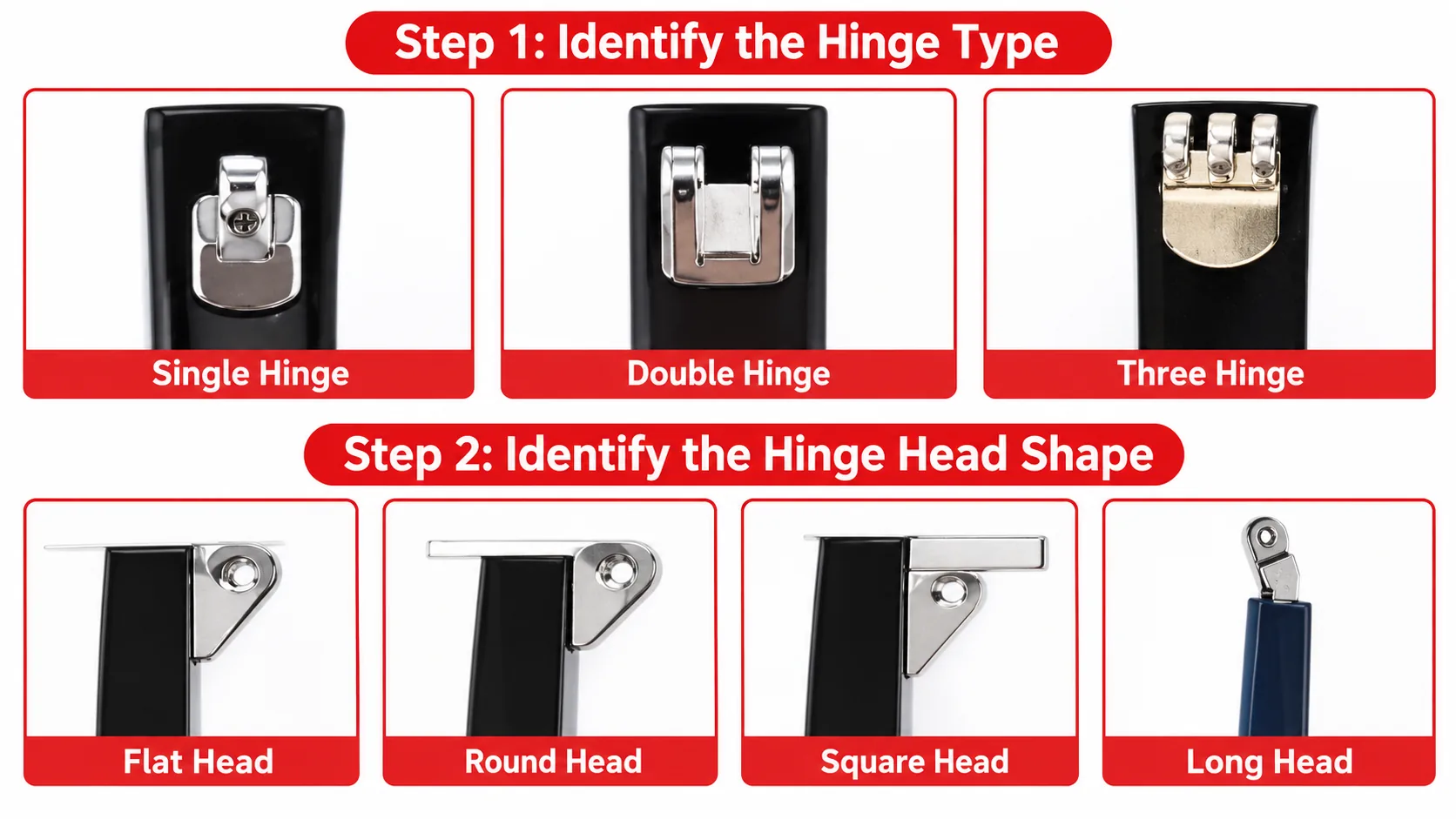
Tooth count is the number of interlocking tabs where the temple meets the front. It sets the width of the hinge block and the number of screw paths.
| Type | Tabs | Characteristics |
|---|---|---|
| Single tooth (单牙) | 1 | Narrowest block, one screw path. Common on slim metal frames. |
| Double tooth (双牙) | 2 | Most widely used interface. Distributes load across two tabs. |
| Triple tooth (三牙) | 3 | Widest block. Used on heavier constructions. |
Head profile is the shape of the tab face where it meets the mating part. There are four profiles, not three. The concave variant is frequently left out of supplier catalogues and is the one most often misread from a photograph.
| Profile | Face geometry | How to recognise it |
|---|---|---|
| Flat head (平头) | Flush rectangular face | No boss, no recess — the mating part sits against a plane. |
| Raised head (凸头) | Protruding boss | A boss stands proud of the face, visible in profile view. |
| Concave head (凹头) | Recessed socket | The mating part sits into the face rather than against it. |
| Long head (长头) | Extended face | The face extends past the block outline, adding reach. |
Flat and concave are the pair that gets confused. In an angled photograph both read as a straight face. They are not interchangeable, and the error is only discovered at assembly — which is why a straight-on photograph matters more than a good one.
Three tooth types multiplied by four head profiles gives twelve theoretical combinations. Nine are routinely available from suppliers; three are not standard tooling.
| Flat (平头) | Raised (凸头) | Concave (凹头) | Long (长头) | |
|---|---|---|---|---|
| Single tooth (单牙) | Standard | Standard | Standard | Standard |
| Double tooth (双牙) | Standard | Standard | Standard | Not standard |
| Triple tooth (三牙) | Standard | Not standard | Standard | Not standard |
The gaps are double tooth with long head, triple tooth with raised head, and triple tooth with long head. These appear on a small share of frames, which is why they are rarely tooled. A frame needing one of them requires a custom run, and the tooling cost is usually disproportionate to the order — in practice that removes the frame from consideration for a retrofit programme.
If you are auditing an assortment of glasses hinge types for a retrofit programme, this is the decision point. Frames that fall into one of the three gaps should be excluded up front rather than quoted and renegotiated later.
A small number of high-volume smart eyewear models do not use the tooth and profile system at all. They use a proprietary hinge assembly — a single integrated part that replaces the endpiece-and-knuckle arrangement entirely. The models most commonly affected are Xiaomi, Huawei and Jiehuan (界环).
For these, tooth count and head profile are irrelevant, because there is no standard interface to match. The assembly has to be quoted as its own part number. Three practical consequences follow: a standard temple cannot be substituted and the incompatibility is not visible until assembly; the correct part is model-specific rather than frame-specific, so two visually similar frames may need different assemblies; and these are the highest-value items in the category, because the installed base is large and original replacement parts are expensive and slow to source.
Matching tooth count and head profile establishes that two parts are the same type. It does not establish that they fit. Four dimensional variables decide that, and they differ between frames that use an identical hinge type.
| Measurement | Effect of a mismatch |
|---|---|
| Temple thickness at the hinge (桩头厚度) | Two or three tenths of a millimetre is enough to stop the temple closing flush against the front. |
| Screw hole diameter | An oversized hole will not hold torque; the joint loosens within weeks. |
| Screw hole centre distance (two-screw hinges) | Determines whether the block aligns at all. |
| Temple cross-section width | Mechanically irrelevant, visually decisive — a thick temple on a slim front reads as an obvious graft. |
This is why a specification that stops at “double tooth, flat head” is incomplete. Type identification narrows the field; only measurement confirms the fit.
A hinge-matched electronic temple introduces specifications that a conventional temple does not have.
| Specification | Conventional temple | Electronic temple |
|---|---|---|
| Weight per side | ~3–4 g (TR90), ~5–7 g (acetate) | ~8 g typical |
| Mass distribution | Spread along the temple | Concentrated behind the ear |
| Charging | None | Two-pin pogo, proprietary cable |
| Service life driver | Hinge and screw | Cell degradation and cable loss |
Weight and balance. An increase of 8–20 g per pair, positioned behind the ear, moves the centre of gravity rearward. The frame slides forward under its own front-heavy geometry and the wearer reads it as a loose fit. Mitigation is either a heavier front — titanium or a metal build — or compensation at the nose pads. A thirty-minute wear test detects this; a thirty-second check does not.
Battery claims. A 110 mAh total configuration (55 mAh per side) is commonly quoted at 6–8 hours. Realistic moderate-volume playback with a live Bluetooth link is closer to 5–6 hours, and continuous calls run lower. The defensible number is the one produced by a stated protocol — for example continuous playback at 60% volume over three consecutive cycles, reported as an average — rather than the headline figure on a datasheet.
The charging cable is a consumable. Two-pin pogo charging uses a proprietary cable that is easily lost and not interchangeable between models. Connector polarity and pin pitch should be confirmed in writing; a reversed cable destroys the cell. On twin-battery designs the left and right temples charge independently, which means a lost single temple makes the pair unusable.
| English | Chinese | Definition |
|---|---|---|
| Temple | 镜腿 | The arm of the frame, from hinge to tip. |
| Endpiece | 桩头 | The block on the frame front where the hinge attaches. |
| Hinge knuckle | 铰链 | The tabbed joint between endpiece and temple. |
| Tooth count | 牙数 | Number of interlocking tabs: single, double or triple. |
| Head profile | 头型 | Shape of the tab face: flat, raised, concave or long. |
| Fold geometry | 合拢角度 | The gap between temple and front when fully closed. |
| Spring hinge | 弹簧铰链 | A hinge containing a spring, allowing outward flex. |
| Pogo pin | 顶针触点 | Spring-loaded contact used for charging. |
Glasses hinge types are classified by tooth count — single, double or triple — and by head profile — flat, raised, concave or long. The two variables are independent, giving twelve theoretical combinations. A third category, brand-proprietary assemblies such as those used by Xiaomi, Huawei and Jiehuan, sits outside this system.
Tooth count is the number of interlocking tabs at the joint. A single-tooth hinge has one tab and a narrow block; a double-tooth hinge has two tabs and distributes load across both. Because tooth count is independent of head profile, two hinges described as double tooth can still be incompatible.
Both appear as a straight face from most angles. A flat head presents a solid plane that the mating part sits against; a concave head has a socket that the mating part sits into. They are not interchangeable, and the difference is usually only visible in raking light or at a low viewing angle.
Twelve theoretical combinations from three tooth types and four head profiles. Nine are routinely stocked; the three non-standard combinations are double tooth with long head, triple tooth with raised head, and triple tooth with long head.
Four measurements are required: screw hole diameter, screw hole centre distance for two-screw hinges, temple thickness at the hinge, and temple length from hinge to tip. Use a digital caliper reading to 0.1 mm, and take the thickness at the thickest point of the endpiece.
No. Three conditions must be satisfied: the hinge must match on tooth count and head profile and must not be a proprietary assembly; the frame must tolerate 8–20 g of additional rear-weighted mass; and the temple thickness at the hinge must clear the front without binding.
A conventional TR90 temple weighs roughly 3–4 g and an acetate temple 5–7 g. An electronic temple with battery and speaker is typically around 8 g per side, adding 8–20 g per pair, concentrated behind the ear.
Two separate requirements apply. Transport documentation — a UN38.3 test summary, and on most lanes an MSDS and transport assessment report — applies to every destination, because it is a shipping precondition rather than a market-access rule. Radio type approval, such as CE-RED in the EU or FCC ID in the United States, is market-specific and depends on where the product is placed on the market. Air carriers apply the transport requirement under the IATA Dangerous Goods Regulations.
The practical starting point for any retrofit programme is one straight-on photograph of the folded hinge and four caliper readings. With those, the variant can be identified in a single exchange. Without them, every quotation is an estimate.
DAQRI supplies replacement smart temples across the nine standard hinge combinations charted above, with proprietary assemblies for Xiaomi, Huawei and Jiehuan available as separate part numbers. Hinge identification support is available before an order is placed: send a photograph of the screw face and the screw hole diameter, and we will return the variant, the stock status, and the tolerances to check on your frame.
Request hinge identification →
 Eyewear Sourcing
 Eyewear Sourcing
 Eyewear Sourcing