

Quick answer: Photochromic glasses (also called transition lenses or color-changing sunglasses) have lenses that darken in UV light and return to clear indoors. Full tint takes about 30–60 seconds; fading back takes around a minute. The DAQRI 526 Photochromic Acetate Series adds a photochromic acetate frame that changes tone as well, so one pair shows three or four different looks depending on the light.
Yes — with one distinction. Photochromic is the generic term for any lens that darkens in UV light. Transitions® is a brand within that category. Every Transitions® lens is photochromic; not every photochromic lens is made by Transitions®. Transitions® is a registered trademark of its respective owner; DAQRI is not affiliated with, or endorsed by, that owner.
People also call them color changing lenses, clear-to-dark lenses or adaptive lenses. All of these describe the same technology.
Photochromic lenses contain light-sensitive molecules — traditionally silver halide crystals. UV light triggers a reversible reaction that darkens the lens. Remove the UV and the lens clears again.
No battery, no app, no swapping between prescription glasses and sunglasses. The reaction is engineered to survive years of daily cycles.
Two things affect the speed: UV intensity and temperature. Cold, bright conditions push a deeper tint — and a slightly slower fade back to clear.
Realistic timings, so you know what to expect:
| Stage | Time |
|---|---|
| Visible darkening starts | Within seconds of sun exposure |
| Full tint | ~30–60 seconds |
| Back to fully clear indoors | ~1 minute |
| Frame tone change (DAQRI 526) | Similar range, slower than the lens |
Photochromic sunglasses are not instant-on sunglasses. If you need immediate darkening behind a windshield, dedicated polarized sunglasses are still the better tool.
Usually not very well. Most car windshields block UV, which is exactly what triggers the lens reaction — so lenses stay relatively light while you drive.
This is the single most common complaint about photochromic lenses, and the reason “photochromic glasses for driving” is such a heavily searched question. The honest answer: one pair of photochromics will not replace dedicated driving sunglasses.
For the DAQRI 526 series, the frame does still shift behind glass, because it picks up scattered UV. The look changes even when the lens doesn’t.
They are worth it if you move between indoors and outdoors several times a day and don’t want to carry two pairs.
Choose them if you: commute on foot, travel light, cycle or hike in changing light, or sit by a bright window all day.
Skip them (or add a second pair) if you: drive long hours in bright sun, need instant darkening, or want maximum glare reduction on water — polarized sunglasses do that job better.
On almost every product: just the lens. The frame color never changes.
The DAQRI 526 Photochromic Acetate Series is different. Its frame is made from photochromic injection acetate, with the color-changing agents inside the material rather than sprayed on as a coating. In UV light, the frame changes tone along with the lens.
That means one pair shows three or four distinct looks:
| Light condition | Frame | Lens (-2 version) |
|---|---|---|
| Indoors | Lightest tone | Clear |
| Under a beach umbrella | Mid tone (sand and water reflect UV upward) | Light tint |
| Half sun / open shade | Deeper tone | Medium tint |
| Direct sun | Deepest tone | Darkest, UV400 |
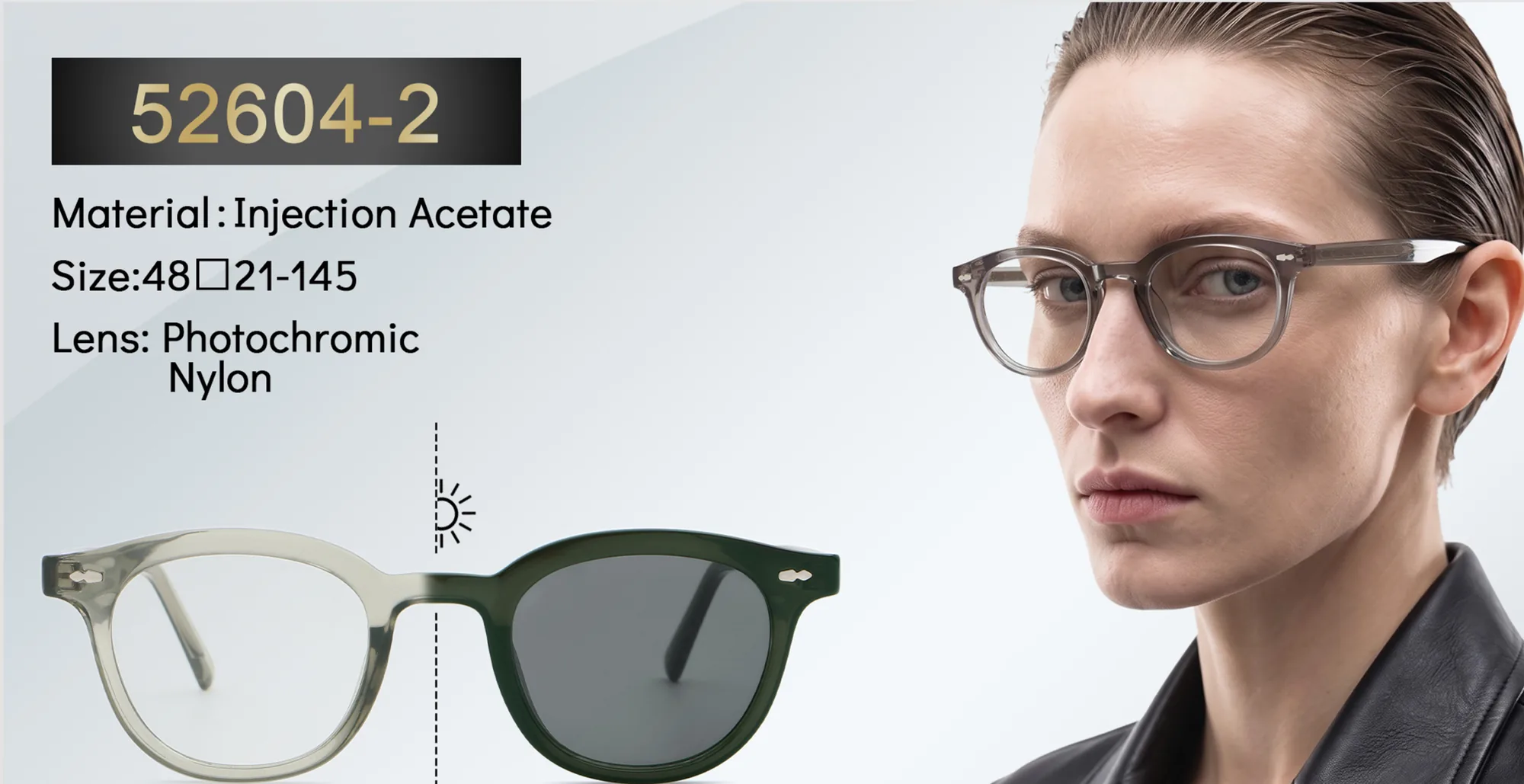
A photochromic acetate frame behaves differently from a painted one: the whole piece reacts, edges and all, so there is no seam where a coating stops.
Nothing to peel or scratch off — the frame shifts as one solid piece of acetate.
Same spot, same glasses, no cuts:
Caption: “Same beach. Same glasses. Two different pairs.”
One honest detail that helps: under an umbrella the frame won’t return to its full indoor tone, because sand and water bounce UV upward. You get a clean three-step gradient — and a fact most creators don’t know.
Where each activity lands:
The lens transition has a ceiling — everyone has seen it.
The frame change is the second surprise, and surprise drives replays and “wait, the frame changed??” comments. It also works in places a lens demo fails:
All phone-friendly, 9–20 seconds. Let the light do the work.
Why it wins: Proof in one static frame. Nobody can call it an edit.
Color changing sunglasses are usually judged on the lens alone — which is exactly why a frame that changes tone alongside it gets so many comments.
| Audience | Pain point | Angle that converts |
|---|---|---|
| Style-first Gen Z & Millennials (18–30) | One pair = one look | “One pair, three tones” |
| Commuters and drivers (25–45) | Carrying prescription + sunglasses | “The last pair you need to carry” |
| Outdoor crew — cycling, fishing, hiking (20–40) | Glare, gear swapping | Field test on shadow lines and water |
| Travel and beach creators (25–40) | Packing light, content variety | “7 days, one pair, seven looks” |
| Gadget and gift buyers (all ages) | Wants a visible reaction | “The gift that changes in front of them” |
Lead with the frame, not the lens:
| Say this | Skip this |
|---|---|
| “The photochromic acetate frame shifts tone in UV light” | “the frame changes color instantly” |
| “UV400 lens blocks UVA and UVB” (-2 version) | “protects against snow blindness” |
| “Deeper tone in cold, bright light — winter films best” | “works identically behind any windshield” |
| “Tint builds in ~30–60s, fades back in about a minute” | “instant, always, everywhere” |
| “The frame change is cosmetic; UV protection is in the lens” | implying the frame blocks UV |
| “Photochromics don’t fully darken behind a windshield” | “perfect for driving” |
That last row matters. Buyers search “photochromic glasses for driving” expecting a yes. Telling them the truth first is what earns the trust — and the link.
| Spec | Detail |
|---|---|
| Frame | Photochromic injection acetate — changes tone in UV light |
| Lens (-2 version) | Photochromic nylon, UV400 — clear indoors, dark in sun |
| Lens (optical version) | Clear AC / blue-light-blocking, paired with the color-changing frame |
| Shape | Retro round / panto, keyhole bridge, star rivet |
| Size | 47□24-145 · 48□23-145 — unisex, fits most faces |
| Range | 14 styles, ~15–20 colorways; each shifts to a different end tone |
| Availability | In stock. Low MOQ, mixed styles and colors, DDP to EU/US/CA/AU/JP/KR |
Looking for stock for the holiday season? See the DAQRI photochromic acetate collection, or read how low-MOQ wholesale eyewear works for small-batch and mixed-color orders.
They behave like ordinary clear lenses — there is not enough UV to activate the tint.
Yes, and the effect is stronger: cold plus bright light produces a deeper tone, and snow reflects UV upward. Expect a slower fade back to clear.
Not automatically. Photochromic describes tint that adapts to light; polarized describes glare filtering. Some lenses do both — check the spec.
Yes. The DAQRI 526 frames are prescription-ready — take them to your optician or order with your Rx through a local provider.
Rinse with cool water first, use a lens-safe cleaner and a microfibre cloth. Avoid hot water and household chemicals, which can craze the coating.
It is a reversible reaction inside the acetate material, not a coating. No peeling, no patchy fade, engineered for repeated daily cycles.
Yes. See below.
If you make eyewear, style, beach, travel, commute or everyday-carry content, this is the easiest demo you will shoot this season — and almost nobody knows the frame trick yet.
Contact the DAQRI team with the word “SAMPLES”, your handle and your country.
Retailers: 14 styles in stock now, mixed colors accepted, DDP covers most major markets. Order by early December and Christmas stock lands before the rush.
Last updated: October 2026 · Written by the DAQRI eyewear team (Nanchang, China — eyewear manufacturing since 2015).
 Eyewear Retail Insights
 Eyewear Retail Insights
 Eyewear Retail Insights