
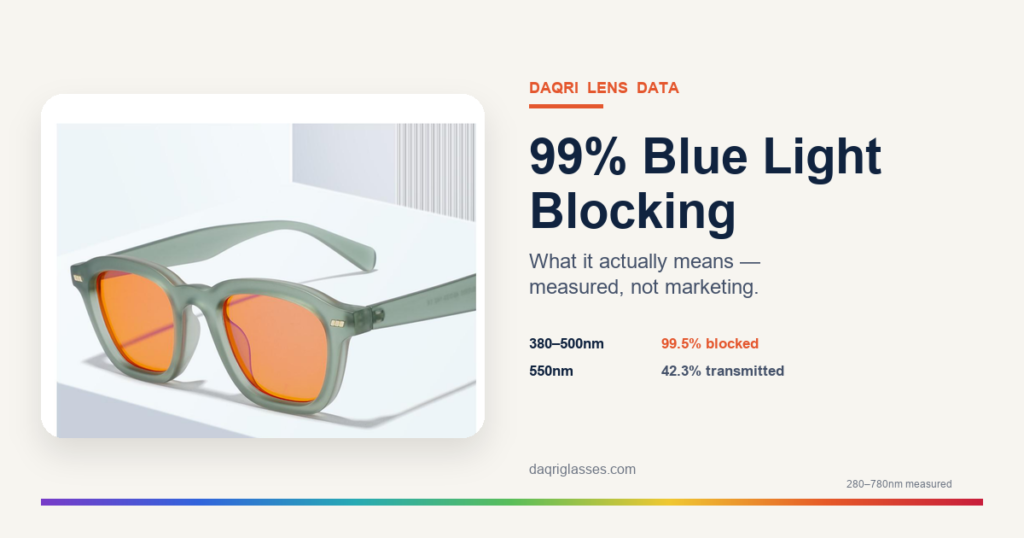
Every blue light blocking brand says “99%.” Almost none tell you 99% of what.
We publish the laboratory curve for our orange lens, measured from 280 to 780 nanometres — the UV, blue, green, yellow and red parts of the spectrum. It shows what the lens does well, where it stops, and why “99%” is not a specification on its own.
This article explains what the number actually means, how to compare tints, and how to verify any supplier’s lens report before you place an order. It also includes the parts of our own report that say FAIL — because those lines tell you what the product is not.
Evidence window: September–November 2026 · Last updated: 17 November 2026 · Reading time: 14–16 minutes · Data basis: orange lens laboratory report, September 2026.
For retailers: this is the explainer you can send to a customer who asks why a measured lens costs more than a commodity pair.
The figures in this article come from a laboratory transmission report for the orange lens, dated September 2026, measured from 280 to 780nm in 10nm steps at the lens centre. The report describes the lens sample tested and is used here as reference data for comparison.
Each colour is supplied with its own transmission report. For private-label orders, the report can be matched to the model, colour and production batch.
It means the lens blocks 99% of light within a stated wavelength range, measured in a stated way.
Without the range, the number is a marketing claim. With the range, it becomes a specification you can compare.
For eyewear claims, blue light is commonly defined as roughly 380–500nm. The body clock is especially sensitive to light around 480–490nm, where melanopsin — the pigment in the retina that signals “daytime” — responds most strongly.
That is why two lenses can both say “99%” and behave completely differently:
| Claim | What it can mean | What it does not tell you |
|---|---|---|
| “99% blue light blocking” | 99% of 380–500nm, averaged | Whether it passes 42% at 550nm |
| “99% of blue light” | 99% of 400–440nm | What happens at 480–490nm |
| “99.9% blue light” | 99.9% of a narrow band | The wavelength range and test method |
| “Blocks blue and green light” | Somewhere between 500 and 560nm | The actual cut-off and transmission curve |
| “Passes EN ISO 12312-1” | A specific set of tests | Which tests passed, and which failed |
If a supplier cannot give you the range, the curve and the test method, the percentage is not a specification. It is a slogan.
The blue light blocking story usually stops at 500nm. The biology does not.
Melanopsin sensitivity tails off into the green. A lens that blocks everything below 500nm but passes most light at 520–550nm is a different product from a lens that blocks through 560nm. Both can call themselves “blue light blocking.” They are not interchangeable.
This is the practical difference between the three main tints:
Most “wavelength charts” online stop at 500nm. For eyewear, three points tell you more than a single headline percentage:
| Wavelength | What it represents | Why it matters |
|---|---|---|
| 500nm | The edge of the blue band | A lens can block 99% below 500nm and still pass visible blue-green above it |
| 550nm | Blue-green | The difference between an evening lens and a deep-night lens |
| 560nm | Green | Where a red lens separates from an orange lens |
If a supplier only gives you one number, ask for these three points. If they cannot provide them, the curve does not exist in a usable form.
In blue light blocking, the colour of the lens is a shortcut for the cut-off wavelength. It is not a quality grade.
The data below comes from a laboratory transmission report dated September 2026. The report measures transmittance from 280 to 780nm in 10nm steps, at the centre of the lens.
From that table we calculate:
The report is a measurement document, not a marketing badge. It tells you what the lens does, and what it does not do.
Data note: the averages in this article are simple averages of the 10nm values in the report, not melanopic-weighted values. They are intended for product comparison, not for clinical or regulatory conclusions.
| Metric | Measured | What it means |
|---|---|---|
| Average transmittance, 380–500nm | 0.49% | Average blue-light blocking: 99.51% |
| Transmittance at 500nm | 1.61% | 98.39% blocked at the edge of the blue band |
| Transmittance at 550nm | 42.32% | Only 57.68% blocked — this is not a “99% blue-green” lens |
| Transmittance at 560nm | 55.08% | 44.92% blocked |
| Average transmittance, 280–400nm | 0.076% | UV blocking: 99.92% |
| VLT | 47.78% | Filter Category 1 — a light filter, not a dark sunglass |
| Report result | FAIL on EN ISO 12312-1, ANSI Z80.3 and AS/NZS 1067.1 | See the next section |

The orange lens is very good at the job it was designed for: removing the blue end of the spectrum. That is what blue light blocking means in practice. It blocks more than 99% of 380–500nm on average, and it blocks essentially all UV.
It also keeps a usable level of visible light. At 47.78% VLT, it is a light filter, not a dark lens. That is why it can be worn indoors in the evening without turning the room into a cave.
It is not a “block everything” lens. At 550nm it still passes 42.32% of the light. That is why it looks orange rather than red, and why it remains usable for reading, cooking and watching a screen.
It is not a dark sunglass. Category 1 is a light filter (43–80% VLT). It reduces blue light, not overall brightness in the way a dark sunglass does.
It is not a driving lens. The report’s road-use check requires Tv ≥75%; the orange lens measures 47.78%. The result is NOT.
Our report does not say “PASS” everywhere. Under the three standards we tested, the overall result is FAIL. The reasons matter, and we are not going to hide them.
Q_Blue: 0.25 (requirement ≥0.60) — FAILED. This is a colour-quality factor for blue signal recognition. A lens that removes most blue light will, by design, make blue signals harder to distinguish.
Tmin (475–650nm): 0.47% (requirement ≥9.56%) — FAILED. The shortest visible wavelengths are very dark through this lens. That is the cost of strong blue filtering.
ANSI colour distortion: green and D65 — FAILED. The lens shifts green and white light enough that it cannot meet the ANSI colour-distortion requirement.
Road use and driving: NOT. The road-use check requires Tv ≥75%. Our lens measures 47.78%. It is not a driving lens.
None of this means the lens is defective. It means the lens is not a general-purpose sunglass, and not a driving lens. It is an evening filter for indoor use.
If a supplier tells you their strong blue-blocking lens passes every sunglass standard, ask to see the report — especially the colour-distortion and road-use lines. In our view, a strong blue filter and perfect colour recognition are, to a large extent, competing goals.
We would rather publish the FAIL lines than pretend they do not exist. If those lines disqualify the lens for your market, you should know before you order, not after.

The three tints are not “good, better, best.” They are different tools. Readers often compare them as “red vs amber vs yellow”; in this article, amber means orange.
| Tint | Best for | What it does well | The trade-off |
|---|---|---|---|
| Yellow | Daytime screen work | Filters part of the blue band; colours stay usable | Weak effect on the body clock |
| Orange | Evening, 2–3 hours before bed | Strong blue blocking; usable indoor vision | Colour shift; not for driving |
| Red | Final 1–2 hours before bed, shift work, jet lag | Blocks further into green | Strong colour distortion; indoor use only |
| FL41 | Light sensitivity, migraine-adjacent use | Filters the blue-green band | Medical-claim risk; separate positioning |
| FL60 | Amber evening filter | Warm, lower-tint option | Not for driving |
Yellow is the easiest first product for a retailer because it looks close to a normal lens. It filters part of the blue band without the strong colour shift of orange or red.
It is a daytime screen lens. It is not a sleep lens, and it should not be sold as one.
Orange is the practical evening lens for most people. It blocks most of the blue band, keeps indoor vision usable, and can be worn for two to three hours before bed.
Our orange lens sits here. It is a Category 1 filter, so it is light enough for indoor use, but it still changes how colours look. Customers should be told that before they buy.
Red filters further into green, often to about 550–560nm. It is the strongest filter and the most disruptive to colour.
It suits the final one to two hours before bed, shift workers, and travellers resetting their body clock. It is not for driving, colour-critical work, or all-day wear.
The red lens is specified by its cut-off range. Ask for the transmission report that matches the colour and model you are ordering.
FL41 is a rose-amber filter designed around the blue-green band associated with light sensitivity. It is not a stronger version of a blue blocker; it is a clinical-style filter with a separate evidence base and a separate claims pathway.
FL60 is an amber evening option in the same frame family. It should be evaluated on its own curve, not on the orange lens’s numbers.
| Customer situation | Best starting point | Why |
|---|---|---|
| Office screen work, colour accuracy matters | Yellow | Filters part of the blue band; least colour shift |
| Evening wind-down, still reading or watching TV | Orange | Strong blue blocking; usable indoor vision |
| Final 1–2 hours before bed, phone in bed | Red | Blocks further into green |
| Shift work, jet lag, irregular schedule | Red | Strongest signal that “daytime” is over |
| Fluorescent-light sensitivity | FL41, with professional advice | Targets the blue-green band; separate claims |
| Child’s everyday wear | Not red | Strong tint; children’s eyewear has separate requirements |
| Driving at night | None of the strong tints | Colour distortion and low VLT |
The most common mistake is buying one pair for everything. Most people who use this category seriously end up with two: an orange pair for the evening, and a red pair for the last stretch before bed.
Do not wear red or deep-orange lenses while driving. They reduce light transmission and distort colour, including traffic signals. Our own report marks road use as “NOT”.
Do not use them as a substitute for treatment. If you have chronic insomnia, sleep apnoea, migraine or another medical condition, talk to a clinician. Glasses are not a treatment for a sleep disorder.
Do not wear strong tints for colour-critical work. Graphic design, electrical wiring, colour matching and some safety tasks require accurate colour perception.
Do not treat children’s tints as a casual product. Children’s eyewear has separate mechanical and UV requirements, and strong tints are not a default solution.
Do not wear them all day. Daytime bright light is useful for anchoring your body clock. The evidence for blue-light glasses is mainly around evening use, not all-day blocking.
Ask these seven questions before you place an order:
If a supplier cannot answer these, the “report” is probably a marketing asset, not a test document.
A lens report is not a PDF to file away. It is a sales tool — if you use it properly.
A single frame family in yellow, orange and red covers three use cases and three price points without three sets of inventory. The customer can compare the tints on the same face, and you can reorder only the tint that sells.
Our BL series is built around this idea:
| Model | Size (lens–bridge–temple) | Weight | Frame | Lens | Colours |
|---|---|---|---|---|---|
| BL3305-99 | 48-23-142 | 31.5g | PC | PC anti-blue light | Orange / Red / Yellow |
| BL5009-99 | 51-20-145 | 20g | TR90 + insert | PC anti-blue light | Orange / Deep red |
| BL17134-99 | 50-19-144 | 20g | TR90 + CP insert | PC anti-blue light | Orange / Red |
| BL83079-99 | 50-19-142 | 18.3g | TR90 + metal | PC anti-blue light | Orange / Red |
| BL83079FL | 50-19-142 | 18.3g | TR90 + metal | PC anti-blue light | FL41 rose / FL60 amber |
Specifications from the October 2026 catalogue. Prescription availability depends on the lens lab and market; confirm before quoting.
“What time of day will you wear them?”
That one question prevents most mismatched sales and returns.
A simple card with the curve and three numbers — blue blocking, VLT, UV — does more than a “99%” sticker. It also gives the customer a reason to trust the price difference between a commodity frame and a measured lens.
“Not for driving. Colours will look different. This is not a treatment for insomnia.”
Those three sentences prevent more complaints than any warranty.
If you are building a private-label sleep glasses line, ask for the report for each colour, not one report for the range. The report should match the model, the lens colour and the batch you are buying. For blue light glasses wholesale buyers, the same rule applies: compare the curve, not the catalogue headline.
Each colour is supplied with its own transmission report. The orange lens report is the reference data used in this article.
It means the lens blocks 99% of light within a stated wavelength range. Without the range and the test method, the number cannot be compared across products. A lens can block 99% below 500nm and still pass 42% at 550nm.
It depends on the range and the use. For an evening lens, strong blocking below 500nm is useful. For daytime colour-critical work, a strong tint may be a poor fit. “Good” is not a percentage; it is a match between the curve and the use case.
The short-term evidence is weak. A 2023 Cochrane review found that blue-light filtering lenses probably make little or no difference to eye strain from computer use. If your goal is sleep, the evening tint matters more. If your goal is screen comfort, treat “blocks 99%” as a product claim, not a treatment.
Blue light is usually defined as roughly 380–500nm. Blue-green extends into the 500–550nm range. A lens can block 99% of blue light and still pass more than 40% at 550nm. That is why “99% blue light” and “99% blue-green” are not the same claim.
The September 2026 report measures the centre of the lens. That is the reference point used for the comparison in this article; it is not an average across the entire lens surface. For order-specific verification, ask for the report that matches your model and colour.
Yes. The report is matched to the lens colour and model; for private-label orders, include the production batch so the report matches the goods you receive.
Red blocks more, but it distorts colour more. Orange is the better balance for most people during the evening; red is for the final one to two hours before bed. Many people use both.
No. Red and deep-orange lenses reduce light transmission and distort colour, including traffic signals. Our report marks road use as “NOT” for the orange lens, and red is further from a driving lens, not closer.
Strong tints are not a default children’s product. Children’s eyewear has separate mechanical and UV requirements, and sleep problems in children should be assessed by a clinician.
No. The evidence is mixed. A small randomised trial of 14 adults with insomnia symptoms found that amber lenses worn for two hours before bed were associated with about 30 minutes more sleep; a 2021 randomised trial in healthy adults found subjective improvements but no significant objective sleep changes. Glasses are a support tool, not a treatment.
VLT is the percentage of visible light that passes through the lens. Category 1 is a light filter (43–80% VLT). It is not a dark sunglass, and it is not designed for bright outdoor sun or driving.
Because the lens does not meet the blue-signal, minimum-transmittance, colour-distortion and road-use requirements of the standards we tested. That is expected for a strong blue-blocking lens. It is an evening indoor filter, not a driving lens. We publish the FAIL lines because they tell you what the product is not.
Yes. Each colour can be supplied with its own transmission report. The orange lens report is the reference data used in this article; ask for the report that matches the colour and model you are ordering.
“99%” is a useful shorthand only after you know what it refers to. For our orange lens, the data is clear: strong blue light blocking, strong UV blocking, a usable level of visible light, and a deliberate trade-off in colour accuracy and road use.
That trade-off is not a flaw to hide. It is the reason the lens works as an evening filter — and the reason it should not be sold as a universal pair.
If you are a retailer, ask for the curve. If you are a buyer, ask which items failed. If you are a brand, publish the numbers for every colour, not just the one that looks best on a slide.
Request the full orange lens report, including the 280–780nm transmission table and the PASS/FAIL lines.
If you are a retailer, distributor or private-label brand, request a three-colour sample kit and compare the curves yourself. Ask for the transmission report for each colour; the orange report is the reference data used here.
Request the orange lens report
Request a 3-colour sample kit
Talk to us about private label →
Educational content only. Not medical advice. Individual results vary. Do not wear red or deep-orange lenses while driving. Blue-light glasses are not a treatment for insomnia or any medical condition.
 Eyewear Retail Insights
 Eyewear Retail Insights
 Eyewear Retail Insights